Loading...
Designing for Active Learning | With Learning Space Designer Ingrid Reineking
In a recent conversation with Learning Space Designer Ingrid Reineking, we discussed what active learning means and how learning environments can be designed to support it.
At its core, active learning shifts students from passive listeners to active participants in the learning process. Through discussion, collaboration, exploration, and hands-on engagement, students take a more active role in how they learn.
For a deeper look at active learning and why it matters in today's classrooms, be sure to check out our previous blog on the topic.
During our conversation, Ingrid challenged us to think about active learning in a broader way. While many people associate active learning with student movement and participation, she explained that active learning also depends on the flexibility of the environment itself.
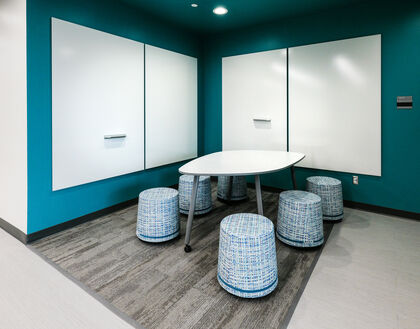
Product in action: ROK Drop
Designing for Active Learning Starts with Flexibility
When asked what first comes to mind when designing a classroom that encourages active learning, Ingrid's answer was simple: flexibility.
For Ingrid, that perspective began years ago during a back-to-school event. As parents toured classrooms and met teachers before the start of the school year, she stepped into a second-grade classroom and immediately noticed something was different.
The room didn't look like the traditional classrooms she was familiar with. Instead of rows of desks and tables, there were only a couple of traditional tables in the space.
Curious, she asked the teacher, "Where is all of the furniture?"
The teacher's response stuck with her: "I let the students decide where they want to sit and learn most comfortably."
Around the room were a variety of seating options—a bench from a van, bean bags, a standing-height counter with stools, traditional chairs, and more. Students had choices, and the space was designed to support different ways of learning.
That experience changed the way Ingrid thought about classroom design. She realized the teacher was creating opportunities for students to learn in the ways that worked best for them, rather than expecting every student to learn the same way in the same seat.
Looking back, Ingrid believes the teacher was onto something. The flexibility and choice built into the classroom created an environment where students could engage with learning in a way that worked best for them.
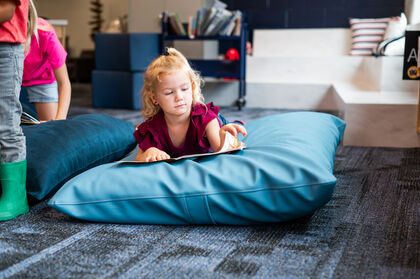
Product in action: FŌM Flopper
Overcoming the Challenges of Active Learning
While flexibility can create powerful learning experiences, Ingrid acknowledges that bringing active learning to life isn't always easy.
One of the biggest challenges is space. Many classrooms have limited square footage, making it difficult to incorporate a variety of learning zones, seating options, and opportunities for movement. However, Ingrid believes active learning is possible in nearly any environment. It often comes down to finding creative ways to maximize the space available and designing with intention.
Beyond the physical space, Ingrid believes mindset plays an equally important role. Active learning doesn't happen because furniture changes. It happens when teachers and administrators share a vision for how students learn best. To make active learning successful, educators need support from school leadership, along with the tools, resources, and confidence to bring active learning strategies into the classroom. When everyone is working toward the same goal, active learning becomes more than a classroom layout. It becomes part of the learning culture itself.
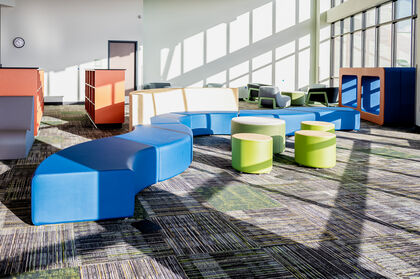
Products in action: Bump Bench, Round Ottoman, Curved Sofa In
5 Design Strategies for Active Learning
Ingrid's Suggestions
1. Use Tables and Chairs with Casters
Mobile furniture allows students to quickly transition between independent work, partner activities, and collaborative learning. Flexible layouts help the classroom adapt to the learning experience rather than forcing students to adapt to the space.
2. Create and Display Classroom Layouts
Develop four intentional classroom layouts and post them in a visible location near the board. As activities change throughout the day, teachers can direct students to move to a specific layout. For example, transitioning from independent reading to group work can be as simple as saying, "Move from layout 1 to layout 3." This creates clear expectations and allows for efficient transitions.
3. Make Use of Every Corner
Every area of the classroom can support learning. Consider creating a cozy reading nook, a comfort corner, or a designated space for de-escalation and reflection. These spaces give students opportunities to recharge, self-regulate, and return to learning ready to engage.
Fōmcore Favorites
4. GiddyUp Ottoman
The GiddyUp Ottoman brings versatility and movement to any learning environment. Students can use it as a traditional seat, a rocking option, or a more active seating solution. Its adaptable design supports student choice while helping create flexible learning spaces that evolve throughout the day.
5. ROK Drop
The ROK Drop provides active learners with a safe way to move while remaining engaged. Its rounded base allows students to rock and shift naturally, helping satisfy their need for movement without distracting their peers. The result is a more comfortable, attentive, and ready-to-learn student.
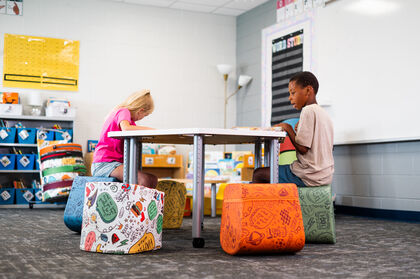
Products in action: GiddyUp, Trapezoid Table
5 Activities That Support Active Learning
Designing a space for active learning is only part of the equation. The learning experiences that happen within that space are what truly bring active learning to life. Here are five simple activities that encourage students to engage, reflect, collaborate, and take an active role in their learning.
1. Appreciative Interviews
Encourage students to interview one another about a meaningful learning experience, a challenge they overcame, or a moment they felt successful. Reflecting on positive experiences helps students recognize growth while learning from the perspectives of their peers (DigitalEd, 2024).
2. Summarize Learning in Your Own Words
After a lesson, ask students to summarize what they learned using their own language. This simple practice encourages students to process information, make connections, and take ownership of their understanding rather than simply repeating what they heard (Central Michigan University, n.d.).
3. Fishbowl Discussions
Fishbowl discussions create opportunities for students to actively participate in meaningful conversations while also practicing active listening. In this activity, one group discusses a topic while the rest of the class observes, listens, and reflects before rotating roles.
By giving students the chance to engage from different perspectives, fishbowl discussions encourage thoughtful participation and deeper understanding. This strategy works especially well when exploring complex topics, classroom debates, or real-world scenarios that benefit from multiple viewpoints (DigitalEd, 2024).
4. Get Students Moving
Active learning doesn't always happen while seated. Giving students opportunities to stand, stretch, walk, or move between activities can help improve focus, engagement, and motivation. Even small moments of movement can help students return to learning feeling refreshed and ready to participate (Gameplan, 2024).
5. The 500-Year-Gap Conversation
Challenge students to explain a modern concept to someone from a different time period. By simplifying ideas and rethinking assumptions, students are encouraged to think critically about what they know and how they communicate it. This activity promotes deeper understanding while making learning more engaging and memorable (DigitalEd, 2024).
Ready to create a space that supports active learning?
Connect with Ingrid, our Learning Space Designer, and start bringing your vision to life. Click here to get started!
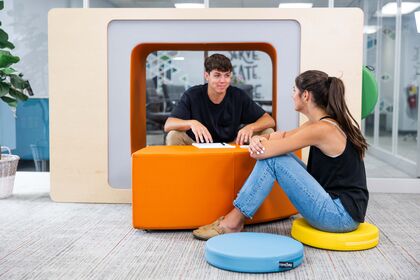
Products in action: Round Lily Pad, Eagle's Nest Enclosure, Eagle's Nest
References
Central Michigan University. (n.d.). 17 Active Learning Strategies to Help You Succeed While Studying. Retrieved from https://www.cmich.edu/blog/all-things-higher-ed/17-active-learning-strategies-to-help-you-succeed-while-studying
DigitalEd. (2024). 5 Active Learning Strategies That Get Students Thinking, Talking, and Doing. Retrieved from https://www.digitaled.com/resources/blog/5-active-learning-strategies-that-get-students-thinking-talking-and-doing/
Gameplan. (2024). 5 Types of Active Learning and How They're Beneficial. Retrieved from https://gameplan.com/news/5-types-of-active-learning-and-how-they-re-beneficial