Loading...
5 Benefits of active learning in the classroom
For years, traditional classrooms were designed around the expectation students learn best while sitting still. Today, educators are rethinking that approach as research continues to show the connection between movement, engagement, and learning. Active motion seating helps support more flexible learning environments by giving students opportunities to move, shift, collaborate, and stay engaged throughout the day.
1. Active Motion Seating Boosts Focus
When students are able to move while learning, their brains receive more oxygen and stimulation, which can help improve attention and engagement. According to the CDC, classroom physical activity can help improve concentration, increase motivation, and reduce disruptive behavior throughout the school day. Small movements, posture shifts, and flexible seating options help students stay engaged longer during lessons and activities.
The Teacher’s Academy notes incorporating movement strategies into classroom routines can help enhance concentration, improve engagement, and support more active participation during lessons. Even short movement opportunities throughout the day positively impact student learning and behavior.
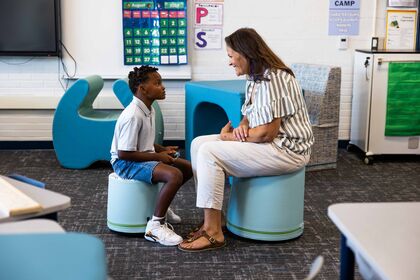
Product in action: ROK Drop
2. Movement Supports Better Memory Retention
Research has shown that movement and active participation support stronger memory retention. Learning environments that encourage standing, shifting, collaborating, and interacting with materials help students engage more deeply with information rather than passively receiving it.
Research from Discovery Education suggests that immersive and active learning experience help increase student engagement, encourage collaboration, and support deeper understanding by involving students more directly in the learning process (The Teachers Academy, n.d.). When students are actively engaged in learning, they are often able to make stronger connections to the material being taught, helping information become more meaningful and memorable.
3. Active Motion Seating Can Reduce Restlessness
Because students are naturally active learners, long periods of sitting-still often lead to restlessness and distraction. Flexible classrooms designed for movement can help reduce fidgeting and off-task behavior by giving students opportunities to move in productive ways throughout the day. Rather than expecting students to remain completely still, active motion seating supports the way many students naturally learn and regulate their attention.
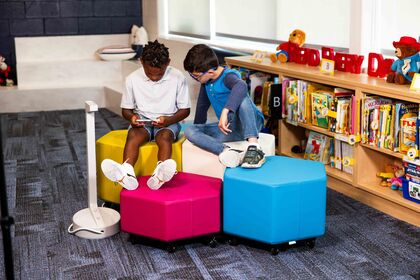
Product in action: Honeycomb Ottoman
4. Flexible Spaces Encourage Collaboration
Flexible, mobile learning environments make it easier for students to connect, collaborate, and share ideas in real time. Seating that can be moved and rearranged supports a variety of learning styles and classroom activities, from independent work to small group discussions. The physical environment plays an important role in encouraging communication, participation, and engagement between students.
A 2025 scoping review published in PLOS ONE found that Active Learning Classrooms were positively associated with student engagement, psychological well-being, and student-centered collaborative learning approaches. Researchers also found that teachers in these environments were more likely to use collaborative and student-centered teaching practices than in traditional classroom settings.
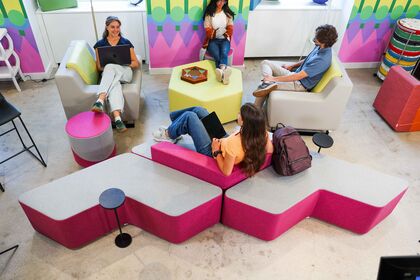
Product in action: Network Series 2.0
5. ACTIVE MOTION SEATING SUPPORTS DIFFERENT LEARNING STYLES
Not every student learns best sitting at a desk all day. Active motion seating helps support a wider range of learning preferences by giving students more choice in how they engage with their environment. These flexible spaces can be especially beneficial for kinesthetic learners and students who benefit from movement throughout the school day. Creating classrooms with varied seating options helps support more inclusive and student-centered learning environments.
As classrooms continue to evolve, movement-friendly learning environments are becoming an important part of supporting student engagement, focus, and well-being. Active motion seating helps create spaces that work with students rather than against the way they naturally learn, move, and interact throughout the day.
Solutions that support active learning
Supporting active learning often starts with creating spaces that give students the freedom to move, collaborate, and stay engaged throughout the day. The Lily Pad encourages collaboration by making it easy for students to move, regroup, and transition between activities as learning evolves throughout the school day. Products like the Rock'n Roller support active seating through gentle rocking motion, helping students stay focused and engaged while still allowing for movement. Flexible seating collections like the Connect Series and Social Series also provide lightweight, adaptable seating options that can easily shift to support individual work, group collaboration, and shared learning spaces beyond the traditional classroom setting.
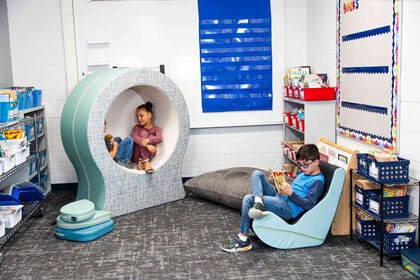
Products in action: F091 Orioles Nest 1, FK007 Lily Pad, F122 Media Chair
References
Centers for Disease Control and Prevention. (2024). Classroom physical activity. U.S. Department of Health & Human Services. https://www.cdc.gov/physical-activity-education/classroom-pa/index.html
Discovery Education. (n.d.). Get students moving to boost engagement and learning. Discovery Education. https://www.discoveryeducation.com/blog/teaching-and-learning/get-students-moving-to-boost-engagement-and-learning/
Sánchez-López, M., Violero-Mellado, J., Martínez-Vizcaíno, V., Laukkanen, A., Sääkslahti, A., & Visier-Alfonso, M. E. (2025). Impact and perceptions of active learning classrooms on reducing sedentary behaviour and improving physical and mental health and academic indicators in children and adolescents: A scoping review. PLOS ONE, 20(2), e0317973. https://doi.org/10.1371/journal.pone.0317973
The Teachers Academy. (n.d.). Moving is learning: Kinesthetic strategies for your classroom. The Teachers Academy. https://theteachersacademy.com/incorporating-movement-strategies-for-your-classroom/